Celestial Hierarchy
Paradise LostThe Celestial Hierarchy is the ranked order of Heaven's angelic host, a vast society whose members appear under distinct rulers, standards, offices, and degrees. It gives visible form to the poem's theology of authority: hierarchy is not presented simply as inequality, but as an ordered relation in which created powers are united under God and the Son of God. Satan's rebellion exposes the hierarchy's central conflict, since he converts equality and liberty into arguments against legitimate rule, while Abdiel insists that obedience to the worthiest ruler preserves rather than destroys freedom.
Structure and Public Order
The hierarchy is introduced as an innumerable host summoned before God's throne. Angels gather from every region of Heaven beneath their Hierarchs, with ten thousand thousand standards and gonfalons raised in the air. The banners distinguish hierarchies, orders, and degrees, while also bearing memorials of eminent acts of zeal and love. Rank therefore has both an administrative and a commemorative function: it organizes the host and records the virtues by which its members have served.
The assembled powers are named as Thrones, Dominations, Princedoms, Virtues, and Powers. These titles are not empty decorations. They designate the graded structure through which heavenly authority operates, and they place each order within a larger unity surrounding God and the Son of God. The hierarchy can therefore appear both ceremonial and political: it is represented through standards, regencies, royal seats, decrees, and collective movement, but its legitimacy rests on the divine order that created and sustains it.
The hierarchy also possesses a shared social life. On the solemn day when God declares the Son of God to be his only Son and appoints him Head, the angels stand in ordered circles around the divine throne, joining song and mystical dance. Their communal meal follows, with angelic food, nectar, fruit, precious vessels, and celestial tabernacles spread through the heavenly plain. The organization is thus not merely a chain of command; it is a society whose order is expressed in worship, festivity, memory, and coordinated movement.
The Decree of the Son of God
The decisive constitutional principle of the hierarchy is God's decree that the Son of God shall reign as Messiah King. God declares that every knee in Heaven must bow to him and confess him Lord, and that the heavenly orders must remain united under his vicegerent. Disobedience is defined not as an isolated refusal but as a rupture of union: the spirit who rejects the decree is cast out from God and blessed vision into utter darkness, without redemption or end.
The decree changes the meaning of rank throughout the hierarchy. The existing orders retain their names and glory, but they are gathered beneath one Head. Abdiel later argues that the Son of God does not obscure their dignity; because the Son of God belongs to their created order while becoming its Head, the laws honored in him return honor to all who obey. Hierarchy therefore functions as a form of corporate unity, concentrating authority without erasing the distinctions among Thrones, Dominations, Princedoms, Virtues, and Powers.
The decree also establishes a contrast between legitimate supremacy and arbitrary domination. God is the creator of the angelic powers and the source of their being, while the Son of God is the one through whom all things were made. Their authority is consequently grounded in origin, worth, and providential care rather than in force alone. This distinction becomes essential when Satan presents the divine decree as tyranny.
Satan's Political Challenge
Satan mobilizes the hierarchy by exploiting its language of freedom and equality. He summons the great powers of the North under the pretense that they are preparing a reception for the Messiah King, but he secretly intends to turn the gathering into a council of resistance. Addressing Thrones, Dominations, Princedoms, Virtues, and Powers, he claims that the new decree has concentrated all power in one ruler and demands humiliating knee-tribute and prostration.
His argument rests on a deliberate inversion. He acknowledges orders and degrees, yet insists that the angels are equally free and therefore cannot reasonably accept monarchy over equals. In this rhetoric, freedom becomes the right to reject any superior authority, while obedience is renamed servitude. Satan's language gives the rebels a political vocabulary with which to reinterpret their inherited place in Heaven, and the hierarchy becomes the arena in which that reinterpretation is tested.
The same dispute reappears after the fall. In Hell, Satan sits on a throne raised by merit and accepted by the rebel host, presenting their defeated condition as the foundation of a new political union. Mammon rejects renewed submission even if God should offer grace, preferring hard liberty in Hell to splendid vassalage in Heaven. The Infernal Council's arguments show that the rebels have not escaped hierarchy so much as reproduced kingship under Satan, whose throne and command structure expose the contradiction within their claim to equal freedom.
Abdiel's Defense of Ordered Liberty
Abdiel alone openly answers Satan within the heavenly debate. He condemns the rebel argument as proud and false and defends God's decree that every heavenly soul should acknowledge the Son of God as rightful King. His defense does not deny freedom; it distinguishes freedom from self-enslavement. To serve the ruler whom God and Nature establish as worthiest is not servitude, whereas serving the unwise or the rebel is a degradation of the self.
Abdiel's position makes the hierarchy a moral structure rather than a merely coercive one. He argues that God has not made the angels less by placing them under one Head; instead, their happy state is more closely united. The Son of God gathers their powers into a common order, and obedience becomes a form of participation in the dignity of the whole. Satan's apparent independence, by contrast, is shown to be bondage to his own pride and rebellious will.
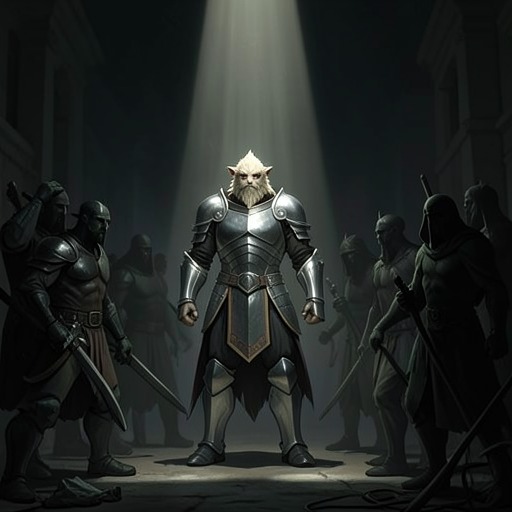
When Abdiel leaves the rebel camp, his isolation confirms the cost of fidelity without invalidating it. He stands alone among innumerable false spirits, yet remains unmoved, unseduced, and unafraid. The hierarchy's principle is therefore dramatized through a single dissenter who refuses the majority's interpretation of liberty. His later blow against Satan begins the open conflict, and the faithful host answers with a cry of praise as the war in Heaven starts.
Expansion into Creation and Human Rule
The hierarchy's ordering principle extends beyond Heaven. During the Creation, the Son of God proceeds through Chaos accompanied by Cherubim, Seraphim, Potentates, Thrones, and Virtues. The heavenly orders witness the formation of the universe as a coordinated procession, linking celestial government with the establishment of cosmic boundaries and forms.
The created world is itself organized through divisions and relations: light is separated from darkness, waters from waters, air is placed between them, and Earth is balanced at its center. Humanity then receives dominion over fish, fowl, beasts, the Earth, and every creeping thing. This does not grant Adam authority over other human beings. Michael later explains that God gave humanity dominion over the animal creation, while leaving human beings free from human masters.
That distinction becomes crucial in the account of the tyrant who rises from Adam's descendants. He claims dominion over his brethren, wages war against those who resist, and builds a city and tower in an attempt to establish an alternative sovereignty. Adam recognizes this as an abuse of the order assigned at Creation: human authority over the nonhuman world has been illegitimately converted into human rule over humans and defiance of God. The poem thus places the Celestial Hierarchy beside two distorted imitations of order—Satan's kingdom in Hell and the tyrant's empire on Earth.
Dispersal and Continuing Significance
The hierarchy is not destroyed by the rebellion, but the rebel angels are removed from it and deprived of their former heavenly names. Their titles are blotted from the heavenly records, and they later acquire new names among human nations through idolatry, falsity, and the corruption of worship. The fall therefore produces both institutional exclusion and cultural afterlife: the former heavenly powers survive as pagan deities and destructive influences, but no longer possess a legitimate place in Heaven's order.
The hierarchy also governs access and mediation. Moses later serves as a figure of mediation when the Israelites cannot bear the direct voice of God, and the Tabernacle gives divine presence a structured dwelling among mortal people. These later arrangements do not reproduce the heavenly hierarchy exactly, but they extend its central pattern: authority is approached through ordered offices, laws, signs, and mediators rather than through unbounded individual will.
The Celestial Hierarchy consequently stands at the center of the poem's political theology. It makes visible the difference between order and domination, between freedom guided by reason and liberty turned into pride, and between rightful rule and rebellious imitation. Satan's challenge gives the hierarchy its dramatic crisis; Abdiel's solitary loyalty gives it its clearest defense; and the ordered Creation shows that the same principle reaches from the ranks of Heaven into the structure of the world and the limits of human power.